Showing posts with label dental history. Show all posts

Monday, October 11, 2010

Teeth: the Historians of the Body

Thanks to Shakira, we all know that "hips don't lie".  While we each have our own experiences regarding the deceptiveness of hips, today's post proves to us that teeth don't lie.  In fact, the teeth are key players in piecing together some of history's mysteries. 

In 2005, archeologists discovered the "Boy with the Amber Necklace" buried within 3 miles of Stonehenge.  They estimate him to be about 14 years old at the time of his death, and surmise that he was an important individual based on his rare jewelry.

 Recently scientists were able to pinpoint where this boy came from - thanks to his teeth!  Redorbit.com explains the process as follows:
As tooth enamel forms in the first few years of childhood, it stores a chemical record of the environment in which the individual lives. Two of the chemical elements found in the enamel (oxygen and strontium) exist in different forms, or isotopes.
The levels of the isotopes found in enamel are informative to scientists analyzing them.
Most oxygen in teeth and bone comes from drinking water -- which is derived from rain or snow. In warmer climates, drinking water contains higher levels of heavy oxygen (O-18), compared to light oxygen (O-16) found in cold climates. So comparing the oxygen isotope ratio in teeth with that of drinking water from different regions can provide information about the climate in which a person grew up.
Strontium -- found in most rocks in small amounts -- also varies according to local geology. The isotope ratio of strontium in a person’s teeth can provide information on the geological area from which an individual lived as a child.
By combining the analysis of both elements in the teeth, archaeologists can point out particular regions where a person may have been raised.
 This has helped shed some light on the importance of Stonehenge.  It turns out that the Boy with the Amber Necklace came from the area of the Mediterranean Sea. Another Stonehenge corpse, known as the "Ansbury Archer" underwent the same testing, and his teeth revealed him to be from the Alpine Hills of Germany.

Read more at Redorbit.com.

Also of interest is this article from the Guardian.

Friday, July 30, 2010

Winston Churchill's Teeth

If you had an extra £15,200 ($23,675) lying around, then you could have been the proud new owner of the dentures worn by Winston Churchill.  The chompers were recently purchased in an auction by a private collector, who also owns the microphone Churchill used to announce the end of the war.  (Do you think he's going to hold the dentures in front of the microphone and use his hands to make the teeth move and re-enact that great moment?  Because I totally would if I owned both the microphone AND the dentures.)

The teeth were expected to go for a mere £5000.

Here is some more Winston Churchill dental trivia, courtesy of newscore and oneindia.com:
  • Churchill claimed to have had terrible teeth and gums and needed complicated dentistry even in his childhood.
  • Churchill always carried a second set of dentures with him as a back-up (although there are no known instances of him ever needing the back-up set - unlike this free-spirited skydiver.) 
  • Churchill appreciated his dentist, Willfred Fish, so much that he nominated him for knighthood.
  • I will name my next pet fish Willfred.
  • Willfred Fish's lab technician was drafted to serve in WWII, but Churchill personally intervened stating that the lab tech would be more important to the war effort if he stayed in London to repair Churchill's dentures.
  • Most babies resemble Winston Churchill.  This doesn't have to do with his teeth, but it's worth mentioning.  Seriously, look at him, now look at a baby.  You see?  And just to be clear - I'm not saying he looks like a baby.  You don't look at him and think, "wow, he looks like a baby".  No no, it's the other way around - babies look like him.  

Friday, April 30, 2010

Dental-related Decor

Dental Ninja reader/dental hygienist Mike Danley has created a comic strip dubbed "Life in the Sulcus". Here's a sneak peek:


Much like this blog, the comics play on the unique knowledge and experiences we in the dental profession share. Head over to dentalposterart.com for more, as well as some deals on vintage dental related posters.

Here's one that's sure to impress patients:


Ok, maybe not so much, but on the bright side, look how far we've come as a profession!

Saturday, March 7, 2009

Sacred Tooth Relic

If any Dental Ninja readers happen to be in Sri Lanka this week, don't miss your chance to visit the Sacred Tooth Relic! Today is the first day of the public exposition which will happen every afternoon until March 16th. Over a million people are expected to visit and pay homage to the tooth, thus invoking blessings of peace and prosperity on the country. More info found in Sri Lanka's Daily News.

What is the Sacred Tooth, you ask? Only the most storied tooth that ever was! Legend has it that after his death, Buddha's body was cremated and somebody retrieved a canine tooth from the pile of ashes. The tooth became a royal possession, and a legend grew that whoever possessed the tooth had a right to rule the land. Consequently wars were fought over possession of the tooth, which I'm sure is exactly what the enlightened one would want.

At one point a King, know as Paandu, decided it would be in everyone's best interest to destroy the tooth. Before he could carry out his plans, a miracle happened and he was converted to Buddhism, and of course he then spared the tooth. The tooth survived other attempts to destroy it and eventually was smuggled to Kandy, Sri Lanka where it resides today.

Here is a picture of the temple housing the canine in Sri Lanka:

Saturday, February 28, 2009

Happy National Tooth Fairy Day

That's right. According to the Census Bureau Daily, February 28th is National Tooth Fairy Day. To celebrate, the Dental Ninja is giving you some "Tooth Fairy Fun Facts."
  • In early European times, it was custom to bury one's baby teeth. This is likely due to the superstition that if a witch happens to get a hold of it, she could put a curse on you. The best way to keep it away from the witches is to bury it.
  • Spanish-speaking countries believe in a "tooth mouse" rather than fairy. The character, known as the "Ratón Pérez" first appeared in a story written for eight-year old Alfonso XIII, as one of his teeth had fallen out. The story stuck, and the character has even been used by Colgate for marketing in Venezuela and Spain.
  • The 18th century French fairy tale "La Bonne Petite Souris" depicts a tooth mouse who morphs into a fairy to help a good queen defeat an evil king by hiding under his pillow. She then tortures him by knocking out all his teeth! This begs the question, why hasn't Disney turned this lovely little tale into a movie?
  • Scotland's lowland areas have a tradition which, like the French fairy tale, combines a mouse and a fairy. The little lads and lassies eagerly await the visit from a white fairy mouse which purchases the teeth with coins.
  • India, Korea, and Vietnam have traditions similar to that of the Japanese in that they throw the exfoliated teeth, however, they aren't as concerned with throwing them straight. Instead, these children throw it and shout a request for the tooth to be replaced by a rodent's tooth. It has something to do with the fact that rodent teeth never stop growing.
  • Children in parts of India will offer their discarded teeth to the sun.
  • The Tooth Fairy as we know her today isn't actually that old. Folklore researchers find the first references around 1900.
Since so many cultures believe in a mouse-fairy combo, I've taken it upon myself to create this composite image to help my fellow Americans visualize what a mouse-fairy might look like:

And, just in case you need a little help explaining the whole Tooth Fairy concept to your little ones, here's a little example from our friends Chris and Brian:

Saturday, February 14, 2009

Abraham Lincoln Dental Trivia


This past week was the 200th anniversary of the birth of Abraham Lincoln. To celebrate, most employers give their workers something that we in the dental world enjoy on a regular basis: a four-day work week!

Although there are more books written about this man than any other American, here are a few nuggets you might not have known:
  • A dentist broke off part of Lincoln's jaw bone while pulling a tooth without anesthesia. The extraction may have taken place in Louisville, KY in Sept. 1841.
  • It has been said that Lincoln was afraid of dentists, which would make sense given what you just learned. In 1862 Lincoln developed a severe toothache and consulted Dr. G. S. Wolf, who had an office near the White House. As Wolf prepared to pull the tooth, Lincoln asked him to wait. Lincoln "took a container of chloroform from his pocket, inhaled it deeply, and sleepily gave the signal for the dentist to proceed."
  • During his campaign for the Presidency, Lincoln liked to recount how during his childhood he was kicked in the teeth by a horse and "apparently killed for a time." I bet if you asked him he'd tell you the experience was a good preparation for a life in politics.
  • Honest Abe, centuries ahead of his time, was the first to sport a "gangsta grill" when he dawned the flashy chompers for the music video debut of his 1859 hit single "Get Ur Union On."
All information was taken from doctorzebra.com and abrahamlincolnarchive.com, except for that last one about the music video. That was actually something I learned from my own research, so, if you need a citation for a research paper, just write "Dental Ninja" and I'm sure it will be fine.

Wednesday, January 28, 2009

Iran's 5200-year-old Dirtly Little Secret

An 12-year excavation project concluded last week, uncovering the mysteries of Iran's "Burnt City." Of particular interest to the Dental Ninja is the discovery of rampant PARAFUNCTION among inhabitants of the Burnt City.

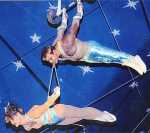
For you anti-dentites, "function" refers to the use of teeth for the purposes for which teeth were intended (i.e. chewing, speaking, smiling, and let's not forget scaring your enemies). "Parafunction" refers to the use of teeth for anything else, such as biting through fishing line or fingernails, opening a package, or holding your wife while flying high above the ground swinging from a trapeze.

Parafunction

Anthropologists discovered various wear patterns in the dentition of the Burnt City inhabitants which lead them to conclude that the mouth was regarded as a "fifth hand."

The Tehran Times explains that teeth were helpful for "weaving wicker, nets and textiles, and in creating artwork with ornamental stones."

What the article won't tell you, however, is something the archeologists don't know: the cause of the Burnt City's downfall. Let us consider a society where all the artists and textile workers spend their lives using their teeth as hands. My theory is that competition drove them to work harder and harder, eventually wearing grooves and holes all through the enamel into the dentin and approximating the pulp, causing EXTREME sensitivity. Eventually there was a breaking point, and half of the city went INSANE from the DENTAL PAIN. (Wow, that sounds like a song title - watch for it on my next album). From this point on, the city imploded on itself. All order was lost and chaos prevailed. My friends, this was indeed a grim demise. Had the ancient inhabitants left us a record, I'm convinced they would have warned us of the dangers of parafunction.

Tuesday, November 18, 2008

It could be worse

There's a book up for auction this week. It was written in 1770 by Thomas Berdmore. Never heard of him? He was the dentist to King George III. This is likely the first ever English textbook on dentistry. Personally, I find Berdmore's insights to be priceless! Here's a few gems, from this article:

He writes of a 23-year-old woman left in a “terrible state” by a “barber dentist”.

“She went to a barber dentist to have the leftmolaris tooth of the upper jaw on the right side taken out,” he says.

“On second attempt he brought away the affected tooth together with a piece of jawbone as big as a walnut and three neighbouring molars.”

He says the “barber dentist” embarked on the ill-fated extraction because he was “uneasy at disappointment”.
Ha ha! I would also consider myself "uneasy at disappointment" but I'd like to think I'll stop before ripping out half of your maxilla!

Berdmore also possessed a rudimentary understanding of orthodontics, instructing fellow dentists (and barber-dentists) to "Pass gold wire from the neighbouring teeth on either side in such a manner as to press upon what stands out of the line." Either that, or you could try to “break the teeth into order by means of a strong pair of crooked pliers”.

He also observed that sugar and smoking were harmful, and that for this reason peasants suffered less dental disease than their noble counterparts.

Anyway, I just wanted to pass this along as a reminder that dentistry has come a long way and you really don't have a lot to be afraid of (relatively speaking).

Friday, September 5, 2008

"Laughing Gas" fun facts

Here's some stuff you probably didn't know about the "laughing gas" you get from the dentist. I just finished taking my Nitrous Oxide competency exam and decided to pass along the more interesting trivia to you folks.

  • It was discovered in the late 1770's by Joseph Priestly. In 1779 Sir Humphrey Davey was the first human to inhale it and described it as "very pleasurable" and "euphoric." He was the one who coined the term laughing gas.
  • It wasn't originally used in a medical setting. From 1800-1844 it was mainly used at social gatherings and sideshows for entertainment.

  • In 1844 a dentist named Horace Wells was attending a demonstration. A peculiar incident happened involving a volunteer who inhaled the gas and began freaking out. (Not everybody reacts the same, and some people really don't like it.) Anyway, this guy started running around the room and gashed his leg open. Horace the dentist astutely observed that the man didn't even react to his wound - as though he didn't feel any pain. The next day Horace had his dentist buddy extracted his abscessed tooth using the gas. Horace felt no pain and proclaimed this to be "the greatest discovery ever made."
  • Originally the dentists had difficulty in delivering high concentrations of the gas due to the crude delivery systems available to them. What were these delivery systems? Ox bladders. (Don't click unless you really want to see an ox bladder.)

  • Wells, who is credited with the discovery of anesthesia, became addicted to the laughing gas and committed suicide at age 33.

  • The exact mechanism of nitrous oxide is still unknown.
So there you have it. Personally, I first had laughing gas when I was 17 and absolutely loved it. I told my dentist that if I had known how great it felt, I would have stopped brushing long ago! I also distinctly remember the feeling of having the dental room rotate around me while I was getting my wisdom teeth extracted. The song on the radio was "When I fall in love" and I remember the experience every time I hear that song.

Let me know your thoughts or any funny stories involving laughing gas. Maybe next year I'll give away a free nitrous oxide treatment to the person with the best story. Maybe.